Showing posts with label The Classroom (ugh). Show all posts

2/02/2012

EFFICIENCY EXPERTS

So, I'm working quietly at my desk during my prep on a new assessment. Just me, no students.
About ten minutes into this exercise, the lights go out. The district, when it "modernized" the classroom, installed a sensor that automatically kills the lights in the absence of motion. Wow! It has the added plus of looking like a certain homicidal computer in a Kubrick film.


Call it Hal 2.0....


And, frankly, even if I opened my blinds at the top of the north wall, very little light comes in from the outside: it's a typical Fresno winter, shrouded in gloomy fog. Kind of like a Bergman film, without all the sunny moments:


Thus, my productivity grinds to a halt until I can get the sensor to detect my presence. Sometimes I can trigger it from my desk by waving my arms. Usually, though, I have to get up and walk around the perimeter of the classroom. By the time the lights are on and I am back in my seat, a minute of prep time has vanished. This will happen every ten minutes, so I could lose as much as four minutes of prep time if I stayed in the classroom, working quietly at my desk.


No doubt some bean counter factored this modest loss of productivity as an acceptable tradeoff for x number of kilowatt-minutes saved by this exercise per classroom per instructional day. Just like they figured that any discomfort experienced by teachers unable to set the thermostat in their own classrooms (previous practice) is outweighed by their ability to save coin by remotely managing the temp from downtown (another "modernization" wonder).


On a similar topic, my district-supplied laptop (a Compaq 6715b) doesn't work all that fast, because of all the district-mandated software running in the background of the underpowered bargain board slows down its performance. Sure, I lose productivity when Power Points crash, data entry doesn't "take" or when a video won't stream properly at a resolution sufficient to make its use worthwhile. But at least the district can keep an eye on me and others using the system! Besides, I can just make up the lost workplace productivity by either staying after school or working x number of hours at home on a real computer, that actually works.


And....the lights just went out again. Hurrah! THE SAVINGS!!!

7/29/2011

WHAT I'VE BEEN DOING (LECTURING)


Continuing self-reflection on more than a decade of Biology instruction at Bullard High School, I think about the time spent in lecture, delivering content. Again, this is an area of instruction that I tend to devote quite a bit of energy to, typically more than my colleagues. There are a lot of reasons for that, and some of them frankly have very little to do with instruction.


Before I was a high school biology teacher, I was a musician and a performer. For me, lecture is performance art, a mixture of low comedy, snippets of song, striking images, provocative questions (and imagery), hopefully wrapped into a narrative that conveys a story of sorts, not merely a recitation of key facts or concepts. The investment that I've brought into such presentations has made me a better teacher, but it also raises the question of how much energy such items take away from other aspects of instruction. I observe, for example, that the time spent lecturing could also be spent with students creating something of their own, doing labs, having experiences. Many of my colleagues are quite a bit more accomplished in these areas than myself, and I would like to see my students have more of these opportunities.


As with testing, the question becomes how much to reduce the amount of time and energy, or at least to the amount of same within the classroom setting. Consider the picture below, which shows a series of file folders. Each orange folder contains a Lecture Guide, which is a partly a 'fill-in-the-blank' recap of key items from the lecture, and partly a series of exercises with illustrations that challenge students to apply the items from the lecture to various problems. Each Lecture Guide also represents one or more Power Point-based lectures and (typically) 2-3 days of instruction.


As you can see from the picture above, that's a significant investment. The Lecture Guides were originally developed as a means to make lectures go faster...but what I discovered was that too many students simply filled in the blanks, didn't do the application exercises, and in general failed to engage with the material. So I abandoned using them this way, returned to conventional lecturing straight into their Composition Books, and used these assessments as means to assessing the completeness of their notes (and as a means for them to self-assess themselves). At the same time, I began the practice of making the class notes available for download from the class blog. Now, the downside of this is the amount of time taken which could've been used for other activities.


Now, I'm loth to abandon these materials that I've invested so much time and energy, and at any rate I have to lecture, because it is the most efficient way to ensure in-class coverage of all the material, and where Biology is concerned, there is much to cover: 50 mandatory standards, 20 additional 'optional' ones, all to be covered in the 140-odd days in the school year prior to the dreaded state tests. At best, you have slightly less than three days per standard!


So, here's the new plan: lecture, as before, but in a streamlined (and fast-paced) way. Expect students to complete their notes on their own time by comparing the outlines and headings of their comp books with the complete Power Points, downloaded as needed from on-campus computers or the class blog. Assess with the Lecture Guides prior to the test, and directly from their Composition Books on the day of the test. I plan to teach it to students with a flowchart that makes explicit the work they must do outside of class just to complete the material. In principle, looking at the number of Lecture Guides, I should be able to free up 20-25 days of instruction prior to state tests, for other activities to enrich the course and promote mastery of the standards.


Anyway...that's the plan.


7/22/2011

WHAT I'VE BEEN DOING WITH MY LIFE (TEACHING)


My blogging has trickled to a stop, in part because I had been wondering if I had anything new to say about the main issues that motivated me to start blogging in the first place. So much has changed in my life, and yet, as far as science education is concerned, so little. Americans are still confused about the difference between science and belief, and a depressingly large number of them neither accept the fact of evolution nor the need to ensure that the theory of evolution by natural selection (TENS) continues to be taught in the public schools.

At the same time, this last semester (and the ensuing six weeks, wherein I taught summer school) has made matters come to a head. It's time for me to start blogging again, even if I don't have any substantial new inroads to report on science education in my area. It's time for me to start doing things like this again, because I am becoming bored with certain aspects of my life, including my work setting. I enjoy teaching, but I am in danger of falling into a rut. I need to make some changes. I need to do more in some areas, but in all frankness I need to give less energy to some of the aspects of teaching that are increasingly robbing me of joy and productiveness. As a friend in high school once said (in a more colorful fashion), you have to make sure the, um, screwing is worth all the...you guessed it....screwing.

So, with that in mind, I've decided to review my own job performance for the last 11 years of teaching biology and other science coursework. What happened? How did I get to Point B from Point A? Most importantly, what has changed, has it changed for the better, and what can I do about it in order to feel useful, productive and (frankly) engaged? I don't want to burn out before I'm 50. Lord knows I see enough colleagues who are just going through the motions after this point, and I would rather do something else with my life than attempt to 'fake the funk' from now until retirement. If I taught for another 11 years, that would be fine, as long as it was as interesting and rewarding as it was prior to 2008.

But I'm getting ahead of myself. The final impetus to publicly return to blogging occurred a few hours ago in my unoccupied classroom, the day after the final session of Summer School ended. I was tidying up the relics of the last few years, including....tests. Lots and lots of tests, written by me, in order to assess student performance in whatever course or courses I was teaching at the time.

That includes, in the order I taught them: Physics, Biology, Earth Science, Chemistry and Environmental Science. All of these were standards-based courses that had a state test to go with them. Three of them (Biology, Chemistry and Physics) count as laboratory science courses on the (a-g) standards for the University of California. All of them count towards my school district's requirement that students have three years of high school science. In each course, every year, I would give 9-12 unit tests which varied considerably in length and difficulty, depending in part on the subject matter, the student population that semester and the intellectual climate of the year in question. Each test typically had two versions to discourage cheating. I rarely reused tests, but typically rewrote them every year, often keeping some of the same assessment items, albeit rearrange and rewritten. Thus, each test represents a substantial investment of time in writing, and (especially in the case of Biology and Physics) rewriting.

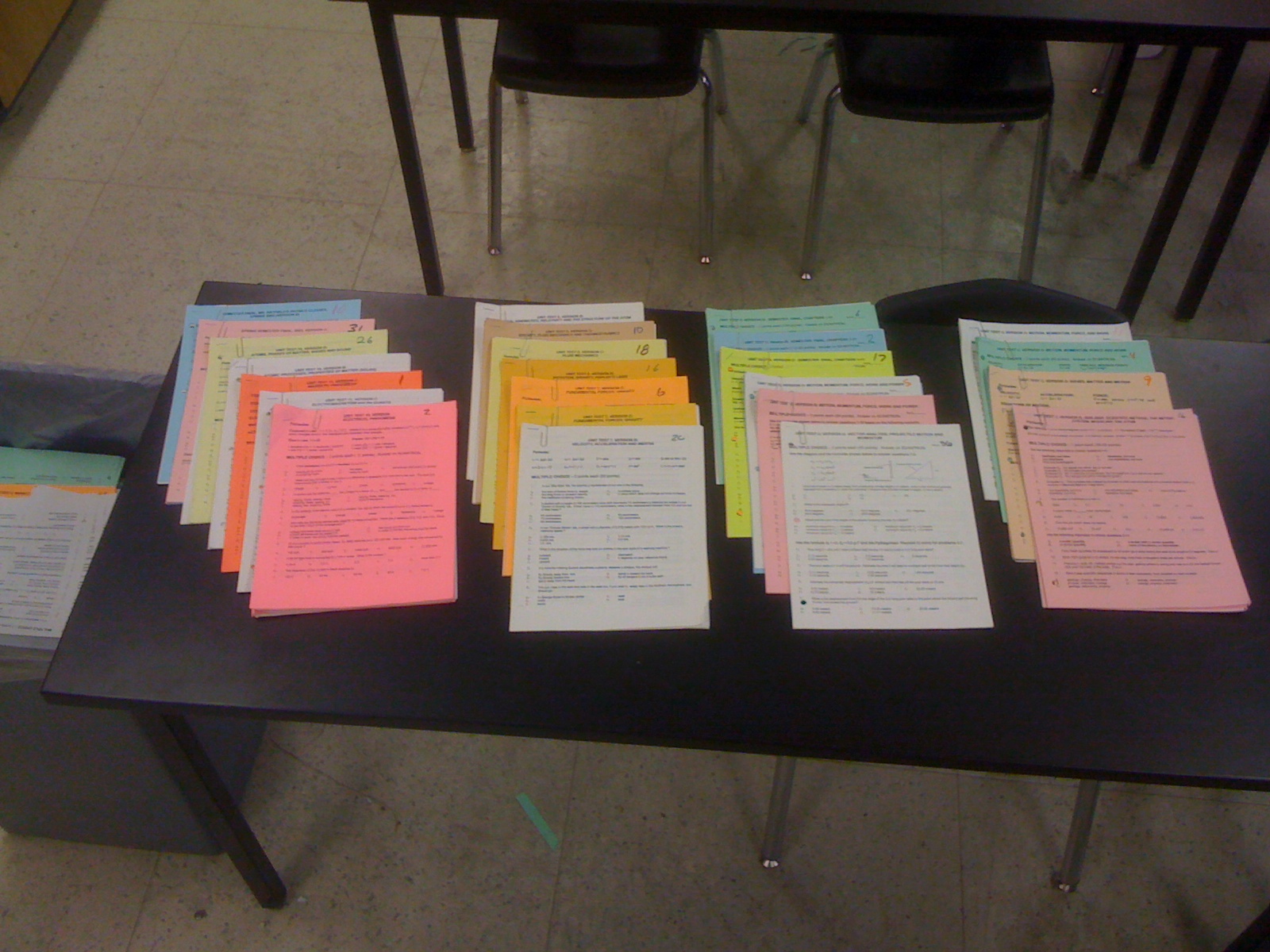
For example, here is a shot that shows collated copies of the Physics tests that I wrote between the fall of 2000 and the spring of 2003, three years of refinement to teach the state standards in Physics. My degree is in the Natural Sciences. It's supposed to be a teaching degree, which means that I had a year of undergraduate physics coursework, plus an astronomy class. I was initially hired to teach sections of Physics and Biology with my degree, which was supposed to qualify me to teach any introductory science class in the state of California. (This was before NCLB became the be-all and end-all of teacher evaluations in this state). Anyway, if you click on the image, you'll see three years worth of the tests of which I'm bothering to keep a few copies. This does not represent all the tests I wrote, just a sample arranged in order to give me an idea what I did when, and (hopefully) help me learn from the experience.


In any and all cases, far more tests were thrown away than were ever kept. As I type this, I need to take some of these piles out to the recycling bins. By the way, the different colors serve two purposes: first, they allow me to distinguish tests within the same year from one another; second, they allow me (and my students) to distinguish at a glance which version of the test they are taking. Each clipped pile actually contains at least two different versions, sometimes (as with a semester final) three. So the above shot, just of Physics tests, actually represents about fifty (!) separate tests. This is just skimming the cream. The rest.....


....into the trash. If you do a little math, you'll recognize that this represents about 16 tests a year. When I began my teaching career, I had a little scheme all mapped out: two regular tests per each quarter, and a final, for a total of six per semester, twelve per academic year. Keep in mind that every time I'm writing a test, I'm writing at least two versions, so it's really 24 per year.

Now, I'm not claiming that each and every one of these tests is an original pearl, full-blown from the head of Zeus. In fact, after the first year, I began recycling questions. The rewriting process is an editing process. Over time, some questions seem more pertinent to the way that I actually teach, or do a better job of encapsulating some key concept and/or state standard. Also, one realizes as you go that you can do things with a test besides assess content knowledge. You can assess effort and obtain documentation about student choices. Over time, I reformatted my tests to improve their readability. I added questions with embedded graphics: charts, maps, and other images. I fussed continually not only with the general length of the test, but the relative emphasis of the various sections. From the very beginning, I have held that a simple, straightforward multiple-choice exam graded by a SCANTRON was not 'the level playing field' desired. There are always a certain number of students who are good at taking such tests, prepared or otherwise. So I would always add other types of assessments.

As you develop assessments, the inner dialogue begins: Lengthen or trim this section? Could this be reworded for clarity? Is there a concept that I am not covering well? Why do students consistently bomb this question? Should I be concerned that most don't get this question, or not? Should I reorder the section? What items to place on an answer sheet?

Hopefully the point is clear. When you rewrite tests, you are engaged in a process of assessment: assessing the course as you teach it, assessing the state standards, comparing what you've taught with what you want them to know and (sigh) what the state expects that they will know, as encompassed in the standards. If every teacher was writing and rewriting their own tests all the time in this sort of process, there would be little need for additional reflection on their own practice. This is a point that many people who are critical of 'teaching to the test' seem to miss. If you write your own tests, then teaching to the tests that you write is not mindless, but inherently self-reflective. Self-assessment through continual reinvention of your student's assessments in light of what your are teaching is far more revealing than any contrived activity mandated, top-down, by whatever hierarchy you are in, precisely because it is authentic.

The short version: While I know that there are many teachers who use the tests from the textbooks, and who simply recycle their tests from year to year, I'm not one of those people. It is those teachers whose 'teaching to the test' tends to be mindless. For me, it comes down to this: which is more likely to be an accurate and fair assessment? Drawing up a list of questions that you want to be answered, and drilling the answers into students? Or, teaching what is needed for conceptual understanding, and then crafting the assessment based upon the most recently-completed rounds of instruction?

I think you know how I would answer that question. It is an irony, then, that I have become disillusioned with the 'standards-based' reform movement's emphasis on testing. My teaching career began as these reforms were being implemented, and initially I felt I was very well aligned with that movement. The truth is, I was and remain a believer in the high-stakes test. After all, when I began my career, I intended to have 12 of them per year. Each test would take up an entire instructional period. I would give additional time at lunch and after school for those who needed it on exam days. Every test would be prepared with a Study Guide given out 2-3 days in advance of the exam date. I would almost always have a Study Session based on that Study Guide after school the day before the scheduled exam, and shamelessly bribe students to attend that Study Session. My internal logic came down to this: since my approach to writing exams involved multiple parts and continual self-assessment, I was heavily invested in the tests. Therefore, I wanted my students to be heavily invested in them. Not only did I weight them heavily, but I used significant time in the school year to prepare and administer them.

That is not, however, what most of my colleagues do. They don't invest much time in preparing or administering tests. They build what are, in my opinion, low-quality assessments that are intended to be administered in half a period, and they do so by "cutting-and-pasting" pre-fabricated questions, almost all of them multiple-choice, from the textbook or associated materials. The attitude seems to be: "Professionals have already developed questions for us to use, so why reinvent the wheel?"

Well. Duh. In order to be creative, authentic professionals yourselves. This is not to say that my colleagues aren't professionals, or shouldn't be treated as such, or that I have nothing to learn from them. Quite the contrary. I genuinely feel that in the first 6-7 years of teaching, that my colleagues were superior to me in some aspects of instruction, most notably setting up and evaluating labs and other classroom activities. I learned much that was valuable by observing them. I know that in such aspects I can still profit immensely from the experience of other veteran teachers.

I have yet, however to find another high school teacher whose tests struck me as either skilled or thoughtful. I am particularly put off by questions from the textbooks, which are invariably simplistic and misleading. And I find myself continually out of step with the agenda of most administrators and many teachers, because of the different ways in which I and others "script" the course, or as we often say, curricular sequence.

My colleagues at Bullard and throughout much of the educational system, most of them are doing their best to teach the students they are given with a series of scripts which were largely crafted for them: state standards, pacing guides, benchmark exams and departmental assessments (more on that stuff later). I, on the other hand, want to write my own script. I want the freedom to satisfy the standards following a curricular sequence that reflects my own continual self-assessment. That is what I used to do most of the time prior to the fall of 2008, and what I would prefer to do now. In my next post, I will explain why the intellectual climate within my district and my state is discouraging to me, and why I am ready to break with my past practice.
2/06/2010

THE COMPLAINING TEACHER

OK, as I've told some people lately, teachers often complain. It's gotten to the point that I can recognize when a complaint is coming from some of my colleagues, and will quickly change the subject when possible when I can anticipate the nature of the complaint, or in some other way 'beg out' of that conversaion. I tend to regard complaining as unproductive.

Why do some teachers complain so much, especially to their fellow teachers?

Part of that is that we are on our own most of the time, in our little fiefdoms, and we tend to like it that way. We tend to be focused on our particular course of instruction and managing our classes, and so when we are asked to do something outside of our comfort zone, many of us don't handle it very well. Isolation tends to breed distrust. There's a general feeling that administrators make a lot of work for us that is not just unnecessary, but counter-productive, and this feeds the natural sense of enmity between 'labor' and 'management.' As my quote marks suggest, I don't buy into those labels entirely. I tend to treat administrators, and expect to be treated by them, as colleagues. After all, they were in the classroom once and they are, by and large, working to support teachers in the classroom.

The other factor is that, in our isolation, we simply don't have adults to talk to. We need a outlet for those things that understandably cause us stress. This leads to the sad spectacle of the teacher who openly complains about administration and district policies to students, on a regular basis. This is, to put it mildly, unprofessional and should be discouraged. It's a measure of our professionalism when we can recognize this tendency in ourselves, and deliberately steer ourselves away from it. I try not to waste instructional time on this, and off-duty I try to not waste my time engaged in gossip with colleagues about management foibles or 'what my little monsters did today.' I can honestly say that I never bring up another student's name in conversation with other adults unless one of us is looking for some specific information that will help us do our jobs better. Gossip for gossip's sake? I can't be bothered.

But, we teachers are only human. We don't usually have adults to talk to, so when we do, we feel the need to share. And a lot of the time, our sharing is about something that impacted us negatively. This can lead a new teacher to pretty quickly sour on the teaching profession, when they encounter a bunch of colleagues who seem to have nothing but a litany of grievances against administrators, parents, students, the district and life in general.

But here's the thing: a lot of the teachers who are habitually, um, bitchy. . . .they are actually pretty happy, overall, with their jobs. Most of us are experiencing some successes, daily. How cool would it be if teachers consciously chose to share our successes, rather than our frustrations? In fact, some teachers at Bullard (following up on this training that I posted about earlier) have done exactly that, and many have reported an improvement in classroom management and in student performance based upon their decision to model a 'social contract' for students and their colleagues.

Good for them! While I went through the training, I have not integrated it into my practice as throughly as others. But, in general, I have to admit that while the program as taught doesn't fit me as well as others, the general attitude and practice cultivated has been a plus for me where I've added it. I have noticed a real change in the campus this year, and I plan to continue to observe how this works out in practice.

Why is this on my mind? Well, because I have made some changes this semester as opposed to last on these lines, and also because this semester I have a student teacher. Not only do I want my junior colleague to not become discouraged by the complaints of others, I want to do a better job of modeling professional behavior in terms of managing the classroom. As one of my colleagues said, it's like having that proverbial angel on my shoulder, and I 'have to up my game' accordingly.

12/11/2009

WHEREFORE EARTH SCIENCE?


I work for Fresno Unified (FUSD). In the past ten years, I have taught all four of the main sequence standards (Biology, Chemistry, Earth Science and Physics) in California, standards that have been in place without modification since they were adopted in October of 1998. You can get a list of all the science standards, by grade level, in this PDF file.

Now, as you might imagine, in order to satisfy the Biology standards, you have a course based on those standards, most typically called 'Biology'. And so I have taught courses called Biology, Chemistry, Earth Science and Physics, and I have taught them all at least twice. I would guess that I might be the only such teacher in Fresno County, and one of the few in the state, who can say that. What can I say? Jack of all trades, master of none, I suppose.

Anyway, I have an unusual familiarity with the standards. But I have never taught an Honors or an AP course, and so the question of which of my students might qualify for the University of California is not exactly my first priority. But circumstances of late have led me to think about this. The UC requires two years of laboratory science, but strongly recommends a third year. And so, in its wisdom, Fresno Unified mandates a third year of science of some sort in order to graduate.

This year I've been lumbered with teaching a course, however, that is not directly tied to the standards, an elective called 'Environmental Science' that will allow juniors and seniors who don't want to tackle Physics or Chemistry a way of earning a third year of science from FUSD, which requires one year of some sort of science beyond the two years mandated by the UC. Well, I have to ask: what is the point of that? Read this carefully: the UC only accepts Biology, Chemistry, Physics and their AP and Honors permutations as 'laboratory science.' That's right, the UC doesn't accept the other main standards-based course (Earth Science) at all! That is because (frankly) it is an inferior course. There are no prerequisites for Earth Science, whereas Biology kids must have passed or currently taking Algebra I (which is, in case you don't know, the number #1 grade-killer in high school).

So, poorly-prepared freshmen are put into Earth Science instead of Biology when the system works right, see...and the UC people know this, so they won't accept it as a laboratory science course. This means that, in order to get that recommended (if not required) third year of laboratory science, a kid who takes Earth Science as a freshman will have to take three additional science courses to qualify for the UC. Somewhere along the way, this led to a whole bunch of juniors opting out of standards-based courses entirely, because they often don't pass Biology the first time they take it. They haven't had much success in science, and they hear how hard Chemistry and Physics are supposed to be, and they punt.

Well, when a kid makes this choice as a junior, they are choosing not to be eligible for the University of California. So, under this circumstance, why treat them as if they still need to take a third year of science? It's not going to give them an advantage in applying to a CSU or a community college. What's the point?

If the point is to make sure they get that third year of science, then I say 'epic fail.' That's just so much 'eat your spinach because I said so' to me. Electives should be enrichment for those who want to take additional coursework in a given area, not a remedial program for people who struggled with past science coursework. Most of the students in my Environmental Science class would benefit more academically from some kind of performing arts elective, frankly.

If the point is to raise the overall science literacy of the population, then again I have questions. The emphasis on rote learning and factoids in order to finesse the standards-based tests works against real science literacy, which involves internalizing the process, practice and critical thinking skills used in science. That's a lot more important more than (say) knowing how many stars are in the Milky Way Galaxy (an actual standard in Earth Science). And, since all the electives we offer are in the life sciences, a student can actually graduate from high school without any general science knowledge in things like electricity, magnetism, changes of state, machines...in other words, exactly the kind of science literacy that people in trades and everyday life are likely to find most useful.

So why is this happening? Well, the short hand answer is standards mania. See, kids in an elective science course still have to take a standards-based test. They get three years of standards-based science, even if it's in a course (like Earth Science, or the elective I teach) that is not considered up-to-snuff by the UC.

That's why all our electives seem to be in the life sciences, because the Biology test is supposed to be 'easier' than the Chemistry or the Physics. Ecology? Environmental Science? Physiology? Zoology? All our juniors in these courses still take a science test, so (the thinking goes) let's make sure it's the Biology CST. Never mind that Biology is actually the biggest challenge to teach due to the combined depth and breadth of the standards, and that you can't actually cover all these standards well in a course that has a narrowed 'elective' focus. In fact, one of the biggest complaints Bio instructors make to one another is how difficult it is for them to cover all the standards in Bio. Ironically, from the teacher's point of view, it is quite a bit easier to cover all the material mandated by the state in the Physics and Chemistry classes! If that sounds hard to believe, remember, I've taught all these courses at least twice, and I know what I'm talking about here.

So what to do here? Under the circumstances, I think we need to rethink our sequence at Bullard. Most of these kids are not going to go to the UC, but all of them are going to be tested in science their first three years of high school. Science typically forms a small part of the API score (about six percent), but under the present system nearly half of the students are going to have no real physical science. Sorry, but if Earth Science doesn't count as a real science for the UC, how can we argue that kids who take it are getting a quality science course?

So, as the saying goes, catch-22. How to best serve the average students? If we send poorly-prepared freshmen into Bio, they tend to fail, fall behind and hate science. If we put them in Earth Science, they are getting a year of science credit with the district but they are essentially a year behind qualifying for the UC, and their chances of taking an AP science course are also significantly diminished. When we turn a third-year elective into a remedial class, we essentially tell that population that science is spinach. Oh, and while I'm on a roll here, my gut tells me that assessing the juniors with a test that's intended to go with a different course is a bad idea, no matter how we slice it. If kids need to take a standards-based test, they need to be in a standards-based course.

What we need is a course that will give freshmen credit with the UC for laboratory science, but which will nurture their curiosity and give them a chance to catch up academically. I don't know if that is really possible, because the UC and the CST's are ultimately not all that well-aligned. None of this would matter were it not for the fact that California (like most states) is so addicted to federal education dollars that they must comply with NCLB.

2/20/2009

COMPETING AGENDAS

I get lots of mail from both my district and my union (the Fresno Teacher's Association, or FTA), and a lot of it is about what they feel the other is doing wrong. I try to take all of this stuff with a grain of salt, recognizing that from time to time parties on either side tend to exaggerate for rhetorical effect.

However, a recent informational flier from FTA contains a few sentences from its President that just ring so true with me based on recent experience:

"In an era of one-size-fits-all curriculum, we are told by (the district) to individualize the material to fit our students' diverse needs. This is extremely difficult since we work in a district that doesn't provide any materials past what the grade level child would need. Many teachers have 5 or 6 different student ability levels in their class and must rely on their ingenuity to create supplemental materials to fill the curriculum void. This takes a huge amount of prep time; something that is seemingly overlooked by District administrators who feel the path to succes lies in the endless studying of data. However, no time is given to do anything with the information gleaned from the data. When the meetings are over, teachers are often assigned menial assessment tasks, or "homework". The combination of the meetings and "homework" interfere with the time to prepare good lessons."

This is painfully true for me. The district requires all Biology teachers to use the same text. Ostensibly the reasons for this are costs and equity issues, as when a student transfers from one school within the district to another. Now, I have no desire to use another text. I think our text is excellent. I just don't believe the district's main interest in these matters is equity for the students. It's about pushing for equality of outcome instead. A uniform text makes standardized assessments within the district more significant statistically, or at least easier to justify in the public square. It is well-known that the district would like to see the pacing guides already inplemented be used not merely to guide, but to direct the pace of instruction. Again, a 'one-size-serves-all' mentality not only at odds with the best practice of instructors, but on a potential collision course when issues of equity are raised.

Now, negotiating between two values with competing claims is a part of life. Think, for example, about the difference between 'fairness' and 'justice'. But, in a better world, administration and labor would share the risks and opportunities where these things are concerned. Instead, management wants standardization of curriculum and equality of outcomes and they'll attempt to hold the teacher responsible no matter what the result. If I depart from the district script in an attempt to better teach or re-teach a core concept to struggling students, I get flak. On the other hand, if I plow ahead regardless of what's in the student's best interests--which inevitably raises the failure rate---I get flak.

More comically, for the last several years the pressure to ratchet up benchmark performances to prepare for standardized tests has become all-consuming, the number one thing we hear from administration. Teach the standards! Take the benchmarks! Evaluate the data! Follow the pacing guide! The mere suggestion that I would like a little more time before I administer the test led to anonymous 'hints' in my mailbox and a supposed 'non-evaluative' visit from an administrator. But just last week, that same administrator approached me about the staggering increase in student failure rates last semester, which I blogged about previously. Again, this was an informal meeting, but the message was pretty clear: administration is worried that I might be failing too many kids and they want me to justify my practice---even though the way I'm teaching hasn't changed. It's the expectations of students that have become increasingly unrealistic.

As this article demonstrates, it is precisely the practice of the public schools that feeds these unrealistic expectations. Teachers, administrators and school districts are threatened with 'real-world' consequences for failure on standardized tests, and so we have responded by increasingly making those tests the primary focus of education. Yet these tests have virtually no effect on most student's grades, which paradoxically emphasize effort over outcome precisely because of the difficulty we have in defending any sort of objective standard for achievement. All new teachers are not very subtly advised to make sure that it is possible for students of below-average ability to earn an above-average grade based on effort.

Yes, that's irony for you: teachers are evaluated largely on the outcome of a standardized test, while the students themselves largely get through not on the basis of any sort of objective, standardized outcome, but by whether they come to class regularly and do the work. But that is a minimal standard for participation, not meeting any bar for excellence! No one would say that a teacher is excellent simply because they never took sick days and put in their forty hours every week. Why would we want students to believe that constitutes any sort of real-world performance standard?

1/30/2009

THE COMING CRISIS

As a general rule, I don't get homework.

Oh, I assign it. I have readings from the textbook that I call, somewhat ham-fistedly, 'Required Assignments" (RA), which essentially just require them to answer questions at the end of that section of the textbook. There are typically 10-12 such questions. Students are graded on whether the work is complete, and whether they are using complete sentences that refer to the original question. Not much of an expectation.

I also have questions embedded in the Labs that typically require them to answer anywhere from 3-10 questions based upon the experience, in the same fashion. We typically use most of the classroom time for the experience of the lab ('gathering the data'), rather than answering questions, so the usual expectation is that they will answer them on their own time, effectively homework. Here I care about more than whether it's in the proper format, and I typically sprinkle a fairly challenging conceptual question in with the easier ones.

I also have Projects, both group and individual, and while I will typically have an 'in-class work day' for such as this, the expectation is that they will have to spend some time at home working on the things.

So, imagine my chagrin when on the most recent unit, I have the following tallies out of 174 students currently on my roster....

  • 25 of the students attempted at least one of the three RA in the unit. That means nearly five out of every six kids did none.


  • 77 of them (less than half) turned in a Project worth almost as much as a test. That means I have nearly one hundred students who haven't turned it in, and it's already one day past the due date.

  • 91 of them (slightly more than half) have turned in the first Lab, which is now two weeks past the due date . . . incredibly, this is true even though I have assigned select kids in each period lunch detention for failing to complete their work, with the threat of Saturday School if they should fail to show.

The level of non-performance is at an all-time low. I normally have between 20-23 percent kids flunk the course each semester. I've been teaching at this school for nine years, and I've come to expect that range of scores so much that if it's a few points high at mid-semester I get nervous and second-guess myself.

Last semester, however, I had 48 percent failure. More than twice as much as my average fail rate just two years ago. Analysis of scores showed that the biggest contributor to the rising tide of 'F' is the failure of students to submit work, especially homework. Nor am I the only one. My colleagues report declining work ethic almost across the board, and often are quick to point out that this seems to be a recent phenomenon. Our AP Bio instructor relayed the fact that in a list-serve nationally with other veteran AP Bio teachers, the hot topic is how the freshmen at their school (the future pool of AP Bio students) seems to have less desire to do higher-level work than in the past, not just leading to declining academic performance but perhaps posing a real threat to the enrollment levels needed at some school sites to justify sections of AP Bio.

What's going on? Is there a pattern here?

I can't prove it, of course, but anecdotally I feel this is the next wave in education: chronic underachievement by a class of young people who have developed differently than past cohorts. Their temptations are greater than when I was in high school, and by and large they are yielding to a mindset, promoted by a media-rich society always willing to take another quarter when they should say, in effect, 'game over.' Students (and to an increasing extent, their parents) really believe that they should always get a 'do-over'....like a video game where you 'die', but get to start over at a preset point where you can presumably immediately try something different other than what got you 'killed'.

Social promotion doubtless contributes to this attitude, as well as a permissive, 'let's-make-sure-we-don't-wreck-their-self-esteem' approach to accountability, but in my experience at least the number of teachers and administrators who model that for students is very small. Most of us are very big on accountability, completing what you start and so forth. So I don't think it's what we're doing at the school sites that is discouraging them from completing homework.

No, it's almost certainly what's going on outside of school that's having the biggest impact. Could one of those things in that regard be video games, computer games, any kind of instant gratification media in which they are encouraged to believe that there is no meaningful penalty for failing to do things right the first time? I am so persuaded.

12/05/2008

THEY TURN DOWN THE HEAT, I TURN UP THE PUNS

Humor being a defense mechanism....

STUDENT: Mr. Hatfield? Could we turn up the heat? Ple-e-e-e-ease? I'm freezing!


Yeah, I get that all the time from my students, Chumley. I tend to keep my classes on the chilly side. While your personal mileage may vary, in my experience students become less attentive above 77-78 degrees Farenheit, so I tend to keep it colder than that (68-72). Sure, I often have to explain to the kid doing their best Tennessee Tuxedo impersonation why I'm not going to turn up the thermostat, but in general my students are more productive. And, on those days in class when we have the hot plates out, the lowered threshold keeps the classroom pleasant.

But, as usual, my school district tends to push these things to the limit. Witness this newspaper coverage of Fresno Unified's failure to provide adequate heat at certain school sites, particularly where I work, Bullard High School.

Just to make things clear, my classroom does not have one of the space heaters the article references, and yes, it has been quite cold: in the mid-40's during much of the morning yesterday, and (I suspect) probably much of today as well. I think I will post temperature readings on the blog later today just to document this stuff for future reference. After reading it, you may wonder, just how does the district expect us to function?

That's a rhetorical question, since I have no idea what the district expects at this point. All I can do is document what I and other clients of Fresno Unified deal with from time to time on this blog. You can click on the label 'The Classroom (ugh)' on the right to find a whole series of posts on this topic, if you have the time and care to sample the 'whine.' Believe me when I say that this latest episode of 'chilled' education is just....

....wait for it....


...the tip of the iceberg.

*****UPDATE******

I pulled out five hot plates and had them running before first period began on Friday. It was about 49 degrees outside when class began, but by mid-morning I had managed to raise my shivering students to 60 degrees. By the afternoon we topped out at 64 degrees. Not optimal, and many of them kept their hoods on, but at least we were able to function: I did a demo of different pigments absorbing or reflecting specific frequencies of light using lasers and solutions that I had previously made by dumping leaves in alcohol (spinach for chlorophyll b, poinsettias for anthocyanin), and we completed notes on the Calvin Cycle.

11/24/2008

HANSON: VOW OF POVERTY?

My union, the Fresno Teachers Association, has made quite a stink over the last two election cycles about the compensation package given to my boss, Superintendent Michael Hanson. The former head of the union, a hardball-playing, take-no-prisoners guy named Larry Moore, won election to the FUSD Board, beating out an incumbent who was sponsored by the local (conservative) political establishment, including the Lincoln Club's Michael Der Manouel and (conservative) talk-radio legend Ray Appleton. Why did Moore win? In part because of the criticism of (former) board member Manuel Nunez, who signed off on Hanson's generous contract....which, incidentally, is not that out of line with big-district contracts elsewhere.

Now, with both Moore and incumbent Supe critic Carol Mills poised to form a new voting bloc on the Board, Dr. Hanson seems prepared to undercut that criticism of his tenure by forgoing a already-agreed-upon pay increase and bonus pay, to the tune of about $42,000.

This is, frankly, a brilliant move. The moment his critics seize upon his contract, Hanson can point out his own sacrifice and unfavorably contrast the unwillingness of union members like yours truly to consider adjustments in their salary schedule or benefits in a time of economic crisis. I have no doubt that such rhetoric is in the works, with the massive state budget cuts projected. Not that I think the Supe will actually move to roll such back right away: the district, under his leadership, has a surplus that is about three times what is mandated by law, giving them a temporary cushion....and another talking point to throw back at Board Member-elect Moore, who constantly has carped about the size of the district's reserves.

I may not agree with the Superintendent on everything, but you have to admit, the guy knows how to sell his message. He's bright, bold, and he knows what he wants to do. It would be a shame if that ability is wasted, and that larger vision lost in skirmishes over personality or past grievances or a football player who shouldn't be allowed on the field, as seems about to happen.

I want the district to succeed.....in raising standards, and graduating more kids, and modernizing the facilities. I just don't want that success to be achieved at the expense of my profession.

11/21/2008

HANSON PLAYS PANGLOSS

Earlier this week, I blogged about FUSD Superintendent Michael Hanson's press conference addressing a controversy at Edison High School, in which a teacher allegedly played 'whistle blower' when a star athlete's 'F' was mysteriously changed to an 'A'. According to the teacher, someone 'higher up' changed it. According to Hanson, there is no evidence anyone but the teacher changed the grade and his press conference pointed the finger of blame squarely at the teacher. That's a bad thing, but it's an isolated thing, and in the best of all possible worlds, this controversy will fade away with the district's reputation intact. In this version of history, Michael Hanson (the district's leading educator) is putting the most optimistic spin possible on this scandal, in the manner of Voltaire's Dr. Pangloss.

Well, let us suppose that Dr. Hanson (er, Pangloss) has the better argument in this case. Just for the sake of discussion, let's presume that the teacher (currently on administrative leave) was the one who actually changed an 'F' to an 'A', and that one can not presume anything one way or the other about the star athlete, and so all the district can do is allow the grade change to stand, and thus allow the athlete to maintain his eligibility.

That would be an unpleasant outcome that would probably end up in court, but at least Dr. Hanson wouldn't be picking a fight with the entire Edison community, its football program and its supporters, who would not only lose their star player, but have all their current season games invalidated and (most likely) lose their former NFL star and community hero coach, Tim McDonald.

Yes, that would be the best of all possible worlds, Dr. Pangloss. The only problem is, the kid in question is clearly ineligible anyway! As this report from KMPH 26 News shows, the athlete has abominable attendance over the last four quarters, non-qualifying athletic GPA in three of those four quarters, and currently has a GPA less than (drumroll, please) 1.00.


In other words, setting aside the teacher's claim, the first move in this matter should not necessarily have been a protracted, expensive investigation of the claim of grade change, but simply a determination of the student's overall status. If he is ineligible anyway, Dr. Pangloss, your administration could've pointed that out and claimed that the student was about to be declared ineligible anyway, and that this incident is no reflection on any particular individual or school community's integrity, and regrettable, etc. That may have been stretching the facts a bit, but it would've kept the faith with all parties publicly while you privately sorted things out. That, Mr. Hanson, would've truly been the best of all possible worlds. Instead, you appear to have gotten yourself into a public relations disaster.

By the way, the well-spoken silver-haired teacher in the video is my colleague, the estimable Jim Horn, doing what he does best: standing up and speaking the truth to power on behalf of his fellow teachers.

11/18/2008

DR. HANSON PLAYS PILATE

My goodness, this is a really UGLY little story. Earlier this year, a teacher comes forward with a sensational claim: that a star athlete with lamentable attendance and a failing grade in his spring 2008 course had his grade changed from an 'F' to an 'A'. claiming a student who cut his class more than 60 times in one semester and failed the course. An administrator at the same school initially confirmed these particulars. Shortly afterwards, the teacher was placed on administrative leave and it was further alleged that his classroom computer was swiped, recovered by administration but not returned to the teacher.

Now, in a substantial (this is not a sound bite) press conference that begins with a bit of rhetorical hand-washing with respect to his goals as a Supe, Dr. Michael Hanson puts the finger of blame squarely on the instructor in question. You can watch the entire performance here.

I sit here and wonder, along with Pilate, 'What is truth?' It's really hard to understand why the instructor would've allegedly blown the whistle on himself. It's equally hard to understand why the administration would find it productive to demonize the teacher. At worst, the teacher is part of the problem, not the sole problem. If there is a school culture in some places in the district where some kids manage to miss class regularly yet end up, in Hanson's words, in Ivy League schools, then I have to say I missed the memo. If a kid has more than 10 absences with me in a semester, they will almost certainly earn a below-average grade. Hanson suggests that this may be a systemic problem, and that's a concern.

Anyway, while I don't agree with everything that comes down the pike from administration, I have to say that I like Hanson's approach personally. He works hard and stays on-message. We are starting to see some gains in performance from incoming freshmen, and our Supe and his team deserve some credit for that, doubtless. After the me-driven, all style-but-no-substance tenure of his predecessor, Hanson's work ethic and willingness to commit new financial resources to areas of need is refreshing.

But...still....was it absolutely the best thing to provide such a detailed breakdown of 'deficiencies in employee performance' ? Absence of evidence (that someone other than the teacher might've cooked the gradebook on June 11th) is not evidence of absence, and there is a little thing called due process. Hanson is doubtless correct that the district will be litigated, but does the stand taken in this press conference makes it more or less likely that things will go well for administration? I have to wonder.

*****UPDATE******

The Fresno Teacher's Association has issued a bulletin to classroom teachers expressing their (to put it mildly) disappointment and concern about how the Edison teacher has been treated, and expressing their doubts as to the teacher's culpability. The story being given to the media by the district is not the same tale that is being circulated by the union. Imagine that! Anyway, while I am inclined to believe it is possible that the classroom teacher may have not been sufficiently diligent with securing the district's computer, I agree with a show of solidarity in support of the teacher, who has not exactly been afforded due process. The union is requesting that we wear black shirts every Wednesday until this matter has been resolved, among other things.

Guess what color T-shirt I have on at the moment?

Yes.

11/02/2008

LOSE-LOSE-LOSE

Just don't feel like working much right now. I'm in a muddle: in a new classroom, behind the district's pacing guide due in part to our trailer situation, and yet expected to jettison another Monday's classes for district-mandated CLAD training. At the same time, I'm supposed to administer the district's 1st-quarter benchmark exam before Wednesday even though my students have yet to cover all of that material.

It's a lose-lose situation for me. Either I blow off the training (risking administrative reprimand) to find time to prep and administer the benchmark, or else I administer the benchmark as is, leading to hideous scores that could land me under an administrator's scrutiny. In fact, it's lose-lose-lose, since every day I'm out of the classroom or doing anything other than the state standards my students fall further behind. In a just world, the district would not require me to take benchmarks now, or compel me to get training that isn't legally required, or put up extra hurdles to getting my students up to speed with the state standards.

I have to confess to a personality flaw. There are few things that bother me more than getting blamed for things that are outside of my control, and I just don't see how I should be held responsible for the (legal) hire of a teacher nine years ago without a CLAD certificate, or for placing that teacher for over two months in a 'classroom' without the ability to do laboratory science, or for the two unscheduled delays in returning that teacher and his classes into a real classroom.

Can I cite the administration for bad faith, poor planning and execution in these matters? Evidently not. Why, then, is it appropriate for me to face the possibility of a poor employee evaluation due to the quirky moves of administration?

10/15/2008

IN LIMBO

The district has postponed our move out of the trailers for the second time in two weeks. To put it mildly, we science teachers are not happy.

I've previously posted about this, and you can read about the trials and tribulations of what is called 'modernization' by clicking on posts with the label 'The Classroom (Ugh)'. There's even a video in one of the posts which tries to humorously contrast the situation I'm in with a past of negligence and (hopefully) a better future. Next year, in Jerusalem!

10/08/2008

RATCHET JOB

We science teachers, we need St. John's Wort, or something. Our scheduled move from out of our trailers at Bullard has been pushed back a week, and there is much wailing and gnashing of teeth from my colleagues, a growing sense of frustration and even despair.

Me? I've already channeled my angst into a YouTube video, which you can see here. I've been checking up on the progress of what is amusingly labeled 'modernization' 2-3 times per week, and I was not entirely surprised by the e-mail from administration informing us of the delay. Frankly, I was skeptical about the original move date ('sometime in the second week of October'), so for it to be bumped to 'sometime on the 16th or the 17th' is hardly the stuff of shock.

But it is a concern. We simply can't do meaningful labs in these settings for certain topics, and science without labs isn't really science: it's a set of largely-unconnected concepts and claims. I can honestly say that in some respects this has been one of my best years as a teacher in terms of pacing, classroom management and organization. Experience, and the energy that I've put into things in order to manage the transition to the trailer, have actually been an overall plus for me and until recently I could honestly say that this was my best year of teaching yet.

But what's happening now is that I'm running out of tricks to make the various non-lab things engaging, and it's in a part of the curriculum (chemistry of life) that really calls out for hands-on experience. I can't lecture every day, or expect them to watch videos or do worksheets indefinitely. I'm going to have to get creative if I'm in here much longer in order to avoid losing the kids. Now, don't get me wrong---I'm a creative person by nature, so I will survive. But my colleagues, who haven't been following the progress of their rooms, who've hung their emotional hopes and dreams on the star of the since-abandoned deadline? They are feeling the strain, and the longer they stay in the trailers, the more the tension increases....

SPACE

10/07/2008

MY VOLUNTEERING DAYS MAY BE OVER

Well, I was a busy bee over the weekend. When I came back I had many fires to put out at my school site. The good news is that it appears I may be in my new room by Oct. 15th. The bad news is that the district is pretty much leaning on me to start taking classes once a week to prep for a test to satisfy CLAD.

Never mind that I was hired without CLAD, or that CLAD is not at present legally mandated for anyone previously hired. The district has simply decided that I will take CLAD training on their dime, or else I will be judged insubordinate. I was given two choices:

  • give up several consecutive Saturdays, and receive some modest stipend at the end of the semester
  • attend 8-4 classes for several consecutive Thursdays, for which days the district will pay for subs
Why is the district doing this? Is it because it is likely to make me a more effective teacher? I am frankly skeptical, and my colleagues who have CLAD haven't said much to lead me to believe that this is going to be anything other than a dog-and-pony show to make the district look good. But let's take the district's desire at face-value, and assume that they are just trying to be proactive and raise the quality of their work force. Why, then, am I not being offered any college credit through either option, both of which are being provided through the Tulare (why not Fresno?) County Office of Education rather than an accredited university? This is the equivalent of 12 units of coursework if obtained through a degree program as described here!

I find this especially galling because, for better or worse, I've tried to be a good soldier. I've taught six periods once when asked. I was a seventh-period instructor for two years, teaching a section that most of my other colleagues strive to avoid. I've taught all four of the standards-based courses, including in one year as an emergency fill-in. I've served on the Site Council both as a Rep and as President. I've sponsored student clubs and went to games, plays, etc. voluntarily on a regular basis. I've done inservices for faculty and helped individual colleagues resolve technical problems. In fact, to some of my colleagues I've become a running joke, the 'guy who volunteers.'

Well, to make a long story short I'm going to take the Thursday option because if I lose my Saturdays, what with working a second job already (church choir director) along with my other interests, I think my wife would, um, KILL me. But the downside is that I'm going to have to 'pick up the pieces' every Friday after a sub day for the rest of the semester and it's going to have a negative impact on my curriculum, and thus potentially those precious test scores that my employer places such a premium on could also be affected. If they are, though, will I be cut any slack from a district evaluator if my scores are below the site average, even though my students are effectively being deprived of more than a week's worth of real instructor time because of the administration's desire that all teachers have some sort of progress toward CLAD? Shoot, I doubt it. This is heads they win and tails I lose.

So....I really don't want to be the next administrator who asks me for a favor.

9/13/2008

TRAILER TRASH!


You ever seen science done in a trailer?

Well, you won't see it in this video. You'll just have to imagine. The good news is that I'm going to be in a better situation eventually. In fact, for the first time in nine years, I'll have more than one sink. Check it out, but keep in mind that all through the country science educators are working in inadequate, sub-standard facilities. I'm about to become one of the lucky ones.

7/24/2008

STRIPPED AND LEVELED


This is what's left of my former room N-43 at the moment. The old concrete risers have been removed, and they've begun plumbing. That's good. The microscope cabinet, which was to have been removed and stored in trailer T-6, is nowhere to be found. That's bad, because I labeled it to be stored and when it wasn't moved right away, put in calls to the supervisor to make sure this was taken care of.
I've got my fingers crossed, hoping they stored that cabinet someplace else and that it will eventually show up. It will be difficult to replace if not!


6/19/2008

ARSON!

(EXPURGATED)

I've just learned that, yesterday, someone appears to have set some of our classrooms undergoing 'modernization' at Bullard ablaze!

I don't know anything more, I will have to go to my site today to see for myself.

*************UPDATE*************

Fires were set in three locations in two adjoining classrooms (N-61 and N-63). The fires along the west wall and storage room of N-61 seem to be superficial in damage, not penetrating the gypsum wall board:


The third fire, in N-63, appears to have damaged a cabinet of a lab station and that will probably cost thousands to replace, though the resistant lab surface on top would probably have survived a room-wide blaze and still be useful:


Still, this is disturbing and, if news accounts are to be believed, could be linked to gang activity whose sole purpose is to demonstrate the relative strength of a given group of hoods to damage public property as compared to their rivals. And the news media are here:


Here's a video, from Channel 47, On Your Side

One more thing: I saw some people give me funny looks over the last few days, that I was taking pictures of science classrooms in the process of being disassembled ('modernization'). Obviously, I had no idea anyone was going to intentionally vandalize the classroom, but I have to say I now have the feeling I wish I had taken more pictures. The good news is that my colleague's teaching materials and personal possessions seemed to have been moved out before this happened. I can only imagine how I would feel if I lost all of the curricula I've generated over the years.

6/17/2008

MODERNIZATION

In the going-slightly-crazy department:

One of my colleagues at Bullard had cabinets and other items which should've been preserved accidentally destroyed by the demolition team. The same thing, as far as I can see, may yet happen to my classrooms if I don't supervise.

So, I'm headed back to Bullard this afternoon to make sure everything is properly stored as I will be teaching out of a trailer next semester. And this is called (ahem) "modernization", which based on yesterday's experience seems almost Stalinist. Hopefully the trailer won't be a five-year plan!

6/04/2008

LOCKDOWN!


Well, we spent more than half an hour on lockdown this morning. This was not a drill, so there was apparently a real concern for student and staff safety based on conduct reports. The lockdown has now been lifted, and we await an explanation from administration.

Fortunately for me, I was in the middle of my prep, so I had no students freaking out in the classroom to contend with. In these circumstances, they all typically try to whip out their cell phones and call mommy, overloading the local service providers and making life difficult in general for emergency personnel. So I'm glad I didn't have to deal with that.

Though, of course, all my doors were locked, as were the doors to my doors. There are no windows at floor level accessible, so I'm pretty well sequestered, and I keep a few makeshift weapons handy by either entrance. Call me paranoid, but growing up on military bases and knowing where all the bomb shelters were seems to have had an effect on my sensibilities. I just kind of think this goes with doing my job, and already having a sort of action plan in my hand in case the 'unthinkable' happens just strikes me as part of the job.


**************UPDATE:****************

It appears that the incident in question may have been a hoax involving possible self-injury on the part of a female student, rather than an actual assault (stabbing was alleged). Well, that would be a relief, but I'm also gratified that our system apparently worked in this case. I'm now off to a staff meeting to discuss our response to the situation. I'm happy with the way our administration is being proactive in handling this matter.